SKU-Level Insights from Smartphone Photos: The Ultimate Retail Execution Reference Guide
Quick answer: SKU-level insights are generated by having field reps photograph a shelf with a standard smartphone, then running the image through AI image recognition that stitches the photos together, detects every individual product, and classifies each one down to the exact SKU — flavor, pack size, and packaging variant included. The output is real-time, per-product data on availability, shelf share, planogram compliance, pricing, and promotional execution, delivered in under 30 seconds at roughly 95% SKU-level accuracy.
In modern retail execution, relying on manual shelf audits is a recipe for missed opportunities. Human audits are slow and error-prone — industry research puts manual retail audit error rates as high as 15-20% — and they rarely scale across a full store network.
SKU-level insights from smartphone photos change that. By combining the standard mobile devices field reps already carry with advanced AI image recognition, Consumer Packaged Goods (CPG) brands can instantly transform raw images into highly granular, actionable retail intelligence. This reference guide breaks down how the technology works, the core metrics it unlocks, and how Snap2Insight powers this digital transformation.
1. How AI Extracts SKU-Level Data
The journey from a simple smartphone photo to a clean data point involves three core phases powered by AI image recognition:
- Quality check and image stitching. AI runs a quick quality check to filter out blurry or too-distant photos that can't produce reliable results, then stitches multiple images of an aisle into a single high-resolution panoramic view — correcting for skewed angles and poor lighting along the way.
- Object detection and bounding boxes. The AI scans each photo and draws a digital bounding box around every individual product visible on the shelf.
- Fine-grained classification. Each bounding box is then classified into a unique product SKU. The model is precise enough to tell a Cheetos Crunchy apart from Cheetos Puffs, or an 8oz bag from a 12oz bag of the same product — picking up on small packaging differences to identify flavor variants, holiday packaging, and promotional stickers.
2. Core Metrics Unlocked via Mobile Photo Analysis
Extracting data at the unique Stock Keeping Unit (SKU) level lets CPG brands track precise execution metrics in real time:
| Metric | What It Measures | Impact on Bottom Line |
|---|---|---|
| OSA (On-Shelf Availability) | Whether a specific SKU is present or out-of-stock (OOS) on the sales floor | Addresses the 4-8% of total sales typically lost to out-of-stocks |
| SoS (Share of Shelf) | The linear percentage or total facings of your SKUs versus direct competitors | Confirms whether you're getting the shelf space owed under trade agreements |
| Planogram Compliance | How the actual shelf layout compares to the agreed planogram or shelf-layout rules | Ensures product placement is executed as planned to protect shelf productivity |
| Shelf Price Auditing | Prices on tags beneath your products and competitors', read via OCR (Optical Character Recognition) | Catches pricing compliance issues, unauthorized markdowns, or missing tags instantly |
| Promotional Execution | Special signage, temporary displays (endcaps, shippers), and promotional price offers | Validates trade marketing spend and confirms co-marketing agreements are live |
3. The Field Workflow: Snap, Insight, Act
For this technology to work, the workflow must place zero friction on field teams. Here's the three-step field workflow:
Step 1: Snap — Uniform Field Data Capture
Field representatives walk the category aisle, taking overlapping, high-resolution photos using standard mobile devices. The software handles poor lighting, varied distances, and minor angle distortions automatically. Capture doesn't have to rely on dedicated reps alone — it can also be crowdsourced, with store associates or shoppers submitting shelf photos directly.
Step 2: Insight — AI Analysis
Images upload instantly to a centralized cloud engine. AI image recognition algorithms stitch the images into a complete panoramic view, identify individual SKU facings, and compare the current shelf state against corporate planograms and historical distribution targets. Using store level inventory data, root-causing to see if inventory is available but not on shelf or if it's a supply chain issue can be tracked. Sales data is used to prioritize Best Shelf Actions by dollar opportunity value.
The processing pipeline generates two outputs simultaneously:
- In-store alerts (Best Shelf Actions): Real-time push notifications go to the rep's device with a prioritized list of missing SKUs and why, so they can fix the issue before leaving.
- Executive dashboards (Instant Retail Visibility): Aggregate OSA performance metrics flow directly to headquarters to identify trends across stores/skus and spot highest opportunity store execution issues.
Step 3: Act — Fix at Store and Win with HQ
Equipped with real time Best Shelf Actions, Field Reps fix issues at the store — including stocking products at the shelf from backroom, working with retailers to zero out phantom inventory issues, trigger ordering or getting the department manager to allocate more space.
Corporate (Headquarters) uses the instant shelf visibility they never had access to, to coach their field reps, work with retailers to negotiate better execution and shelf space.
4. Overcoming Edge Cases: Why Accuracy Matters
Achieving true SKU-level accuracy requires an AI platform built to handle real-world store conditions. Snap2Insight's deep-learning engines are specifically trained to manage:
- Dynamic packaging changes: rapid updates for seasonal branding, localized language variants, or promotional bonus packs.
- Visual obscurities: partial obstructions from price tags, shelf-talkers, structural pillars, or glass refrigerator door reflections.
- Deformed shapes: non-rigid packaging such as flexible bags (chips, pet treats) and vacuum packs that change shape when handled.
FAQ
What is SKU-level data extraction?
It's the process of using AI image recognition to identify the exact product variant — not just the brand or category — in a shelf photo, including pack size, flavor, and packaging edition, and reporting metrics per individual SKU.
How accurate is AI SKU recognition from smartphone photos?
Snap2Insight's platform runs at approximately 95% SKU-level accuracy, validated on an ongoing basis against human-reviewed ground truth. See our trust and performance metrics for the full methodology.
What's the difference between object detection and classification in shelf recognition?
Object detection locates and draws a bounding box around each product on the shelf; classification then identifies exactly which SKU that box contains — the two-step process is what makes fine-grained recognition (down to pack size and flavor) possible.
How fast do CPG brands get results from shelf photos?
Results are typically available in under 30 seconds from photo submission to in-app availability, with the AI's own processing time under 15 seconds.
Can AI handle damaged, deformed, or partially obscured packaging?
Yes — production-grade shelf recognition models are trained specifically on non-rigid packaging (bags, pouches), partial obstructions (shelf-talkers, pillars, glare), and frequent packaging updates, which is what separates a real-world-ready platform from a lab demo.
The Snap2Insight Advantage
Snap2Insight converts shelf-edge photos into your most profitable data asset. With industry-leading speed to result — under 30 seconds — and roughly 95% SKU-level accuracy, we give CPG brands and retail merchandisers the exact visibility needed to eliminate out-of-stocks, protect shelf share, and drive predictable sales growth.
Ready to get the key missing insight at the speed of sight? Explore how our platform fits your existing retail needs.
More Knowledge Shelf
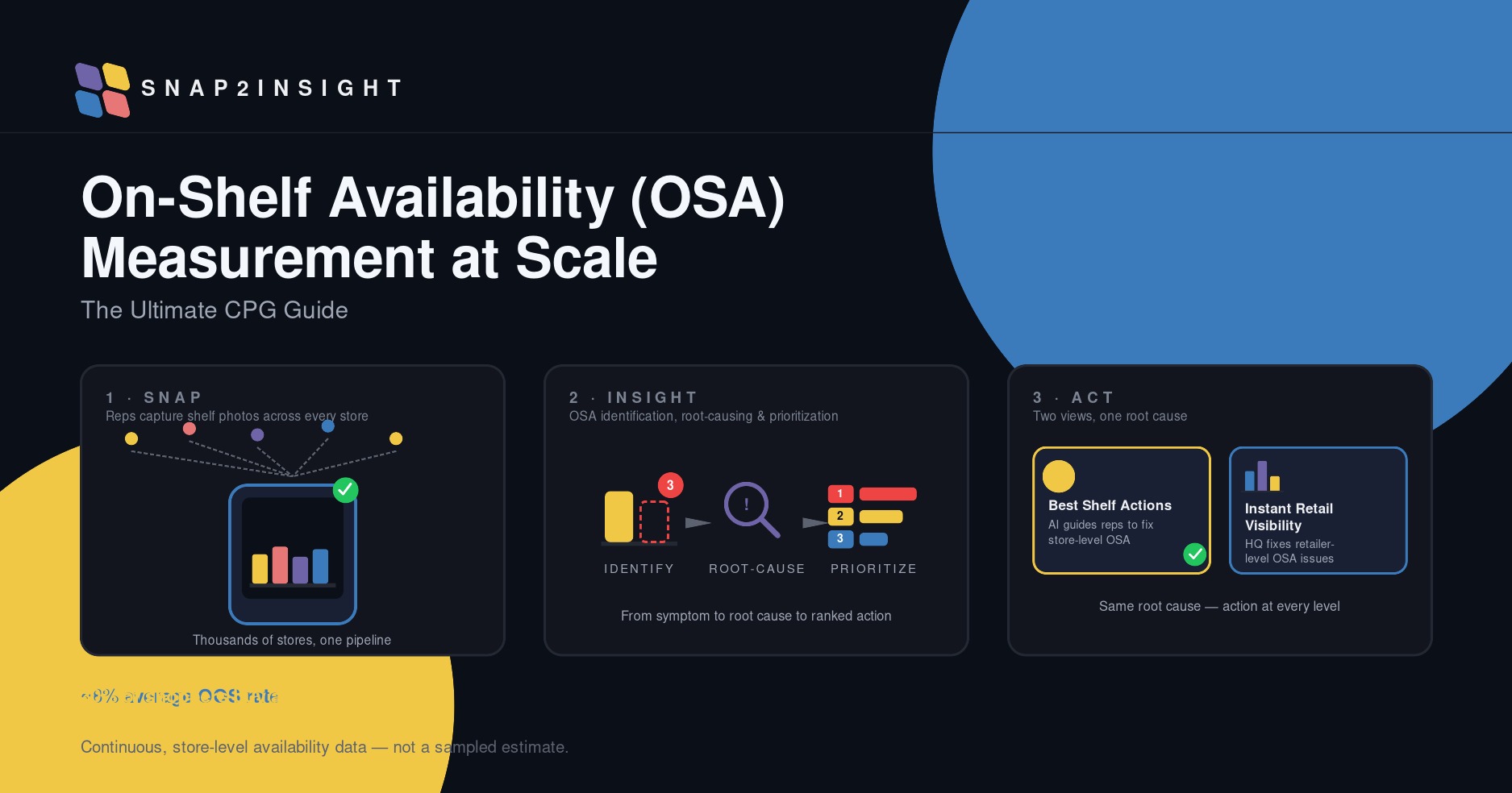
How to Perform On-Shelf Availability (OSA) Measurement at Scale: The Ultimate CPG Guide
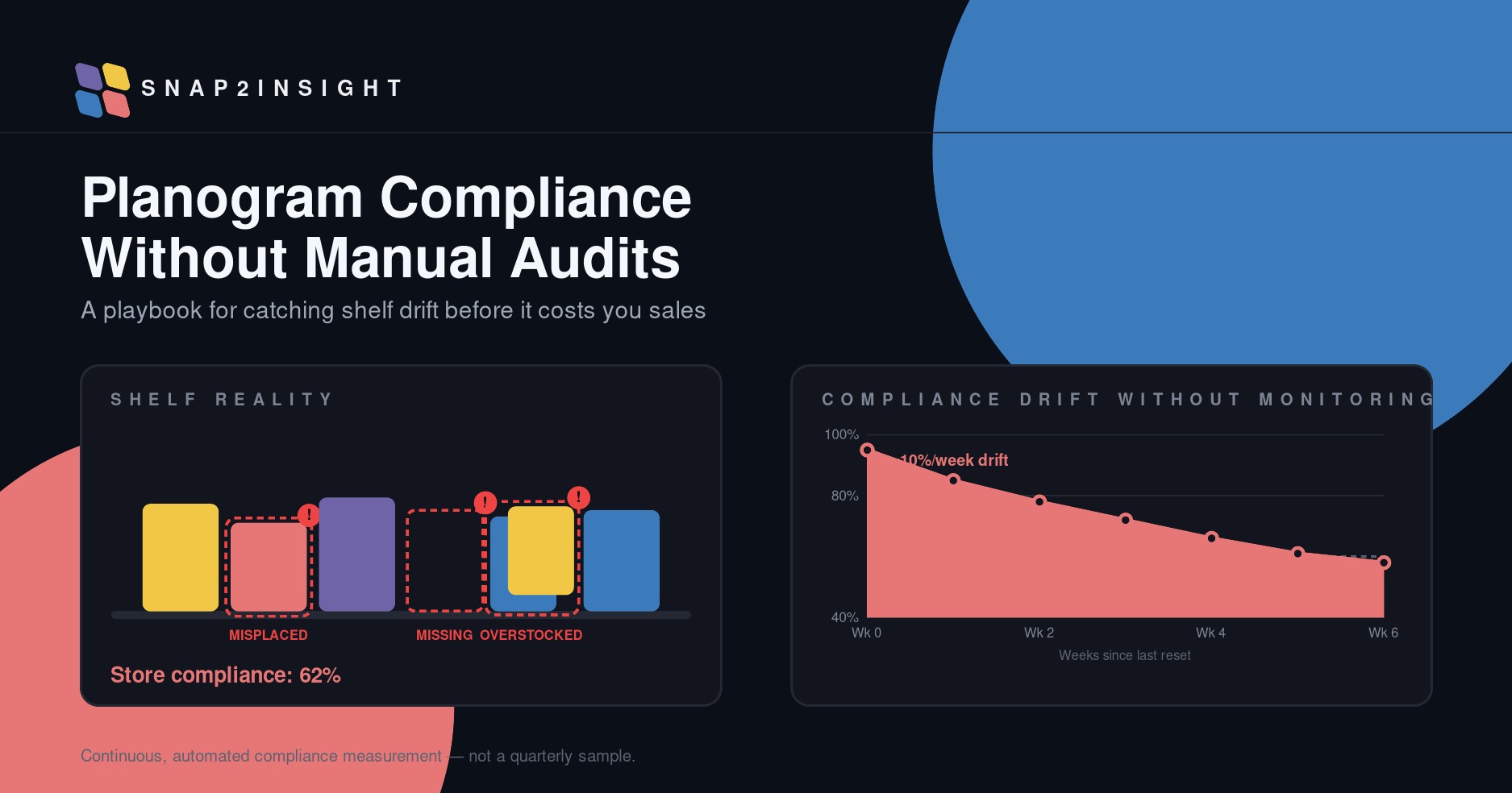
Planogram Compliance Without Manual Audits: A Playbook
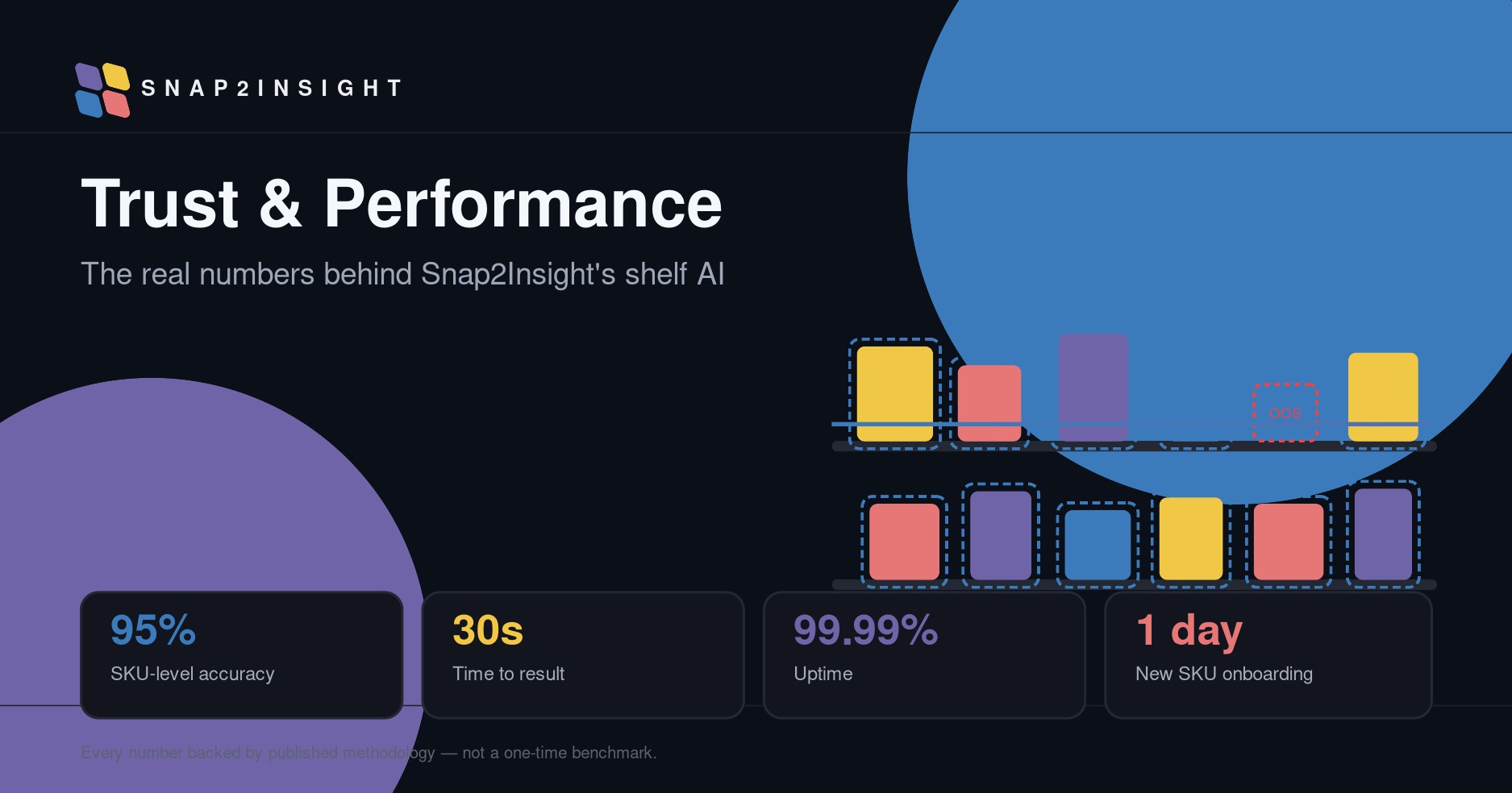
Trust & Performance: The Real Numbers Behind Snap2Insight's Shelf AI
How AI makes the Perfect Shelf possible at Retail
AI-Powered Shelf Visibility: How Snap2Insight Is Transforming Retail Execution

AI Image Recognition for Retail Execution: Frequently Asked Questions

Checklist: Is Your Brand Ready for AI-Powered Retail Merchandising?

How AI Transforms CPG Revenue Growth Management: Smarter Insights for Optimized Retail Execution
Ready to Unlock SKU-Level Shelf Data?
Talk to our team at Snap2Insight to see how smartphone photos can power your retail execution.